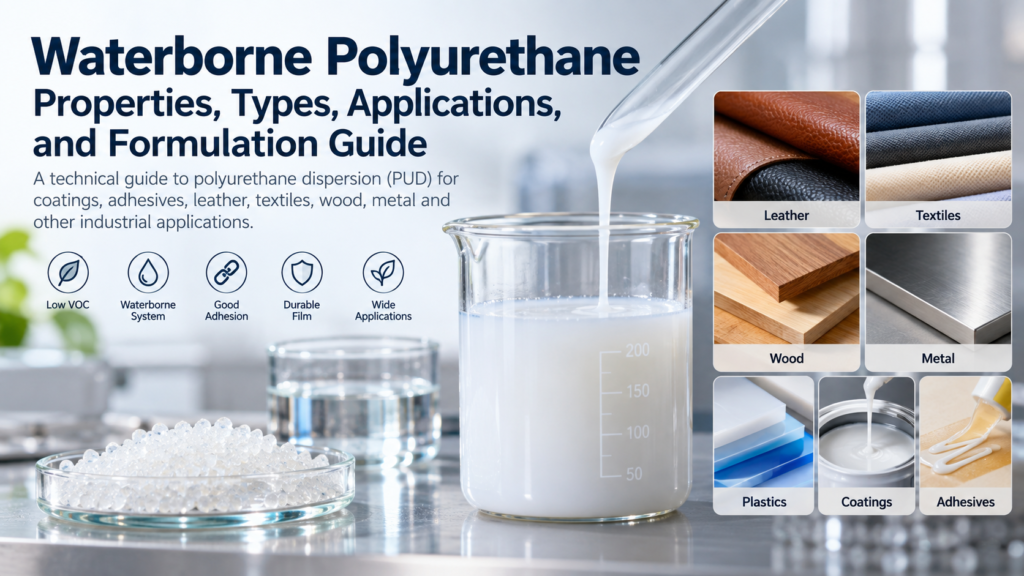
Waterborne polyurethane (WPU) has become an important alternative to conventional solvent-based polyurethane systems for coatings, adhesives, textiles, leather, plastics, and other industrial applications. By using water as the primary dispersion medium, waterborne polyurethane systems can help formulators reduce the use of organic solvents while maintaining a broad range of performance characteristics.
However, not all waterborne polyurethane systems perform the same way. The choice of polyol, isocyanate, chain extender, hydrophilic chemistry, particle structure, and crosslinking approach can significantly affect hardness, flexibility, adhesion, abrasion resistance, water resistance, chemical resistance, drying behavior, and overall film performance.
This guide explains what waterborne polyurethane is, how polyurethane dispersions are made, the major types of WPU, their key properties and applications, and the formulation factors that should be considered when selecting a polyurethane dispersion for an industrial application.
What Is Waterborne Polyurethane?
Waterborne polyurethane is a polyurethane system in which water serves as the primary dispersion or continuous medium instead of an organic solvent. The polyurethane polymer is present as dispersed particles or, depending on the system, as a water-compatible polymer phase.
The terms waterborne polyurethane, water-based polyurethane, and polyurethane dispersion (PUD) are closely related, but they are not always interchangeable. In the coatings and adhesives industry, PUD generally refers to an aqueous polyurethane dispersion, while waterborne polyurethane is a broader term covering polyurethane systems designed for waterborne applications. In the coatings and adhesives industry, PUD generally refers specifically to an aqueous polyurethane dispersion, while waterborne polyurethane is a broader term covering different types of polyurethane systems designed for waterborne applications.
A typical waterborne polyurethane is built from several key components:
- Polyol – influences flexibility, hardness, hydrolysis resistance, chemical resistance, and other properties.
- Diisocyanate – contributes to the polyurethane backbone and strongly affects mechanical properties, weathering, and color stability.
- Chain extender – controls molecular structure and can influence hardness, strength, and flexibility.
- Hydrophilic or ionic groups – help the polyurethane become dispersible or stable in water.
- Water – serves primarily as the dispersion medium and can also participate in the chemistry during certain preparation processes.
The final performance of a PUD depends not only on these individual components but also on their ratios, molecular structure, particle size distribution, degree of branching, ionic content, and crosslinking design.
How Is Waterborne Polyurethane Made?
Waterborne polyurethane is produced by designing a polyurethane polymer that can be dispersed and stabilized in water. The manufacturing process must balance polymer molecular weight, hydrophilic character, particle stability, and final performance.
The main raw materials are polyols, diisocyanates, and chain extenders. Depending on the chemistry, additional components containing ionic or nonionic hydrophilic groups are incorporated to make the polyurethane suitable for dispersion in water.
1. Polyol Selection
Polyols are an important part of the polyurethane backbone and have a major influence on the final properties of the dispersion and its dried film.
Common choices include:
- Polyether polyols – often provide good flexibility and hydrolytic stability.
- Polyester polyols – can provide high mechanical strength, hardness, and adhesion.
- Polycarbonate polyols – can provide a combination of mechanical performance, hydrolysis resistance, and weathering durability.
- Hybrid polyol systems – can be used when formulators need to balance flexibility, hardness, adhesion, and durability.
The choice of polyol should be based on the intended application rather than on one property alone.
2. Diisocyanate Selection
Diisocyanates react with polyols to form the polyurethane structure. Both aromatic and aliphatic or cycloaliphatic diisocyanates are used in waterborne polyurethane chemistry.
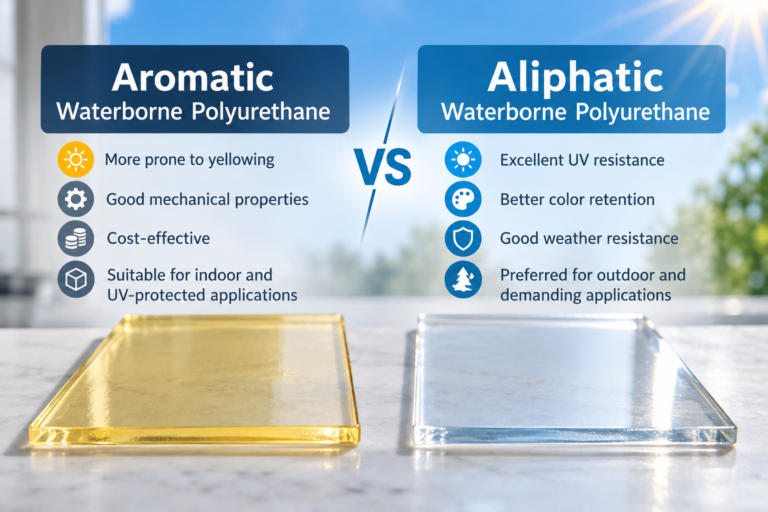
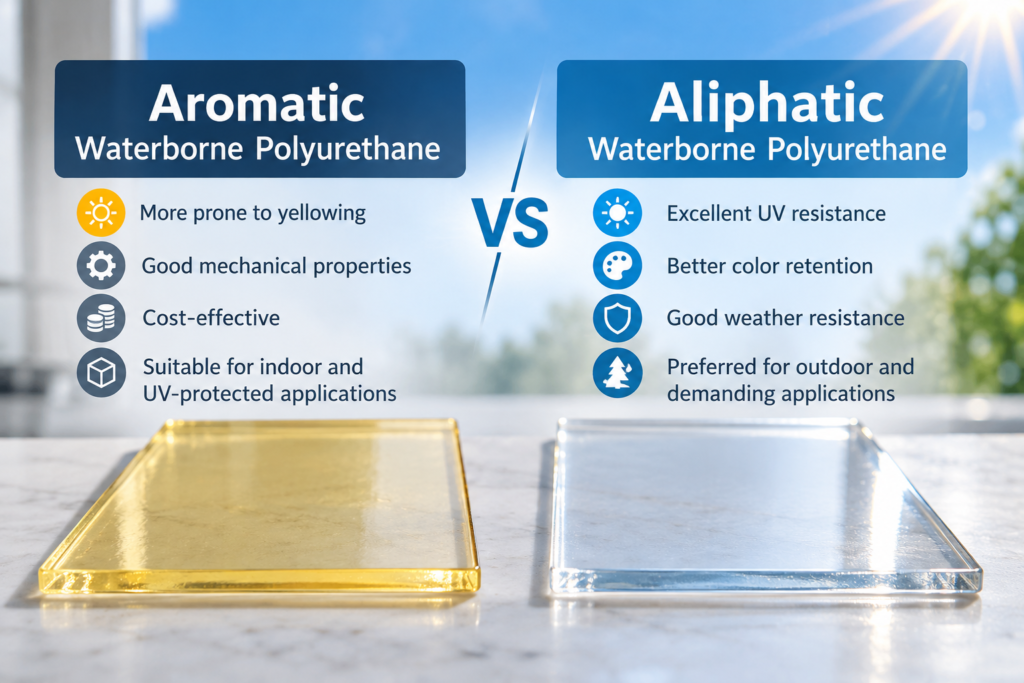
Aromatic isocyanates can provide strong mechanical performance and are commonly used where color stability and long-term weathering are not the primary requirements.
Aliphatic and cycloaliphatic isocyanates are often selected when color stability, light resistance, and weathering performance are important.
Therefore, the isocyanate structure can have a significant impact on the performance requirements of the final coating or adhesive.
3. Incorporating Hydrophilic Groups
Unlike conventional solvent-based polyurethane, a waterborne polyurethane must be designed so that the polymer can be dispersed and remain stable in water.
This is commonly achieved by incorporating ionic or nonionic hydrophilic groups into the polymer structure.
Anionic systems are widely used in commercial polyurethane dispersions. Cationic and nonionic systems are also available for applications where different substrate interactions, compatibility, or formulation characteristics are required.
The amount and type of hydrophilic functionality must be carefully controlled. Too little can make dispersion difficult or reduce storage stability, while excessive hydrophilic character can negatively affect properties such as water resistance.
4. Chain Extension
Chain extension is used to increase molecular weight and modify the structure and performance of the polyurethane.
Depending on the manufacturing process, chain extension can be carried out using compounds such as diols or diamines. In many aqueous polyurethane systems, diamine chain extension contributes to the formation of polyurethane-urea structures.
Chain extension can affect:
- Tensile strength
- Hardness
- Flexibility
- Abrasion resistance
- Adhesion
- Film integrity
The timing of chain extension is also important because it interacts with the dispersion process and the development of polymer molecular weight.
5. Dispersion in Water
After the polyurethane or polyurethane prepolymer has been prepared, it is introduced into water under controlled mixing conditions.
Depending on the chemistry and manufacturing process, the polymer can self-disperse because of its internal hydrophilic groups, or additional processing steps may be required to achieve the desired particle structure and stability.
The result is an aqueous polyurethane dispersion containing polymer particles distributed throughout the water phase.
Particle size, particle-size distribution, polymer structure, ionic content, and solids content can all influence the behavior of the finished PUD.
Common Manufacturing Approaches
Several production approaches are used to manufacture waterborne polyurethane dispersions.
Prepolymer dispersion process
In the prepolymer approach, a polyurethane prepolymer is first prepared and then dispersed into water. Chain extension may occur during or after dispersion.
This method is widely used because the polymer structure can be designed before the water-dispersion stage, allowing manufacturers to control molecular architecture and final performance.
Acetone process
In the acetone process, an organic solvent such as acetone is used temporarily to reduce viscosity and facilitate processing of the polyurethane.
The polymer is subsequently dispersed into water, and the solvent is removed from the final dispersion.
This approach can provide additional flexibility in controlling polymer molecular weight and processing viscosity, although solvent recovery and removal become important parts of the manufacturing process.
Melt dispersion and related processes
Other manufacturing approaches can disperse polyurethane without relying on the same solvent-processing sequence. These processes can be attractive when manufacturers want to reduce or eliminate certain processing solvents.
The appropriate manufacturing method depends on the polymer chemistry, target molecular weight, solids content, equipment, particle characteristics, and required end-use performance.
Types of Waterborne Polyurethane
Waterborne polyurethane can be classified in several ways, including by ionic character, polyol chemistry, isocyanate chemistry, and curing mechanism. These classifications are useful because they help explain why different polyurethane dispersions behave differently in coatings, adhesives, and other applications.
Waterborne Polyurethane by Ionic Character
Waterborne polyurethane dispersions are commonly classified as anionic, cationic, or nonionic systems according to the type of hydrophilic functionality incorporated into the polymer.
Anionic polyurethane dispersions contain negatively charged groups that help stabilize the polymer particles in water. They are widely used in industrial coatings, adhesives, leather finishes, textiles, and other applications.
Cationic polyurethane dispersions contain positively charged functional groups. They can provide different interactions with substrates and other formulation components and may be useful where cationic compatibility or specific surface interactions are required.
Nonionic polyurethane dispersions rely primarily on nonionic hydrophilic structures rather than ionic stabilization. These systems can offer advantages in certain formulations where ionic interactions or electrolyte sensitivity are concerns.
The ionic character of a PUD can influence particle stability, substrate interaction, compatibility, water sensitivity, and formulation behavior. Therefore, the choice should be based on the complete formulation rather than on ionic type alone.
Waterborne Polyurethane by Polyol Chemistry
The polyol is one of the most important components determining the structure and performance of a polyurethane.
Polyether-based polyurethane dispersions are often selected when flexibility, low-temperature performance, and hydrolytic stability are important.
Polyester-based polyurethane dispersions can provide high strength, hardness, abrasion resistance, and adhesion. However, the specific polyester chemistry should be considered when long-term hydrolysis resistance is critical.
Polycarbonate-based polyurethane dispersions can provide a useful combination of mechanical strength, hydrolysis resistance, weathering performance, and durability. They are often considered for demanding applications where long-term performance is important.
Some systems use hybrid or mixed polyol chemistry to balance properties such as hardness, flexibility, adhesion, water resistance, and durability.
There is no universally best polyol chemistry. The appropriate choice depends on the required balance of performance, processing conditions, cost, and end use.
Waterborne Polyurethane by Isocyanate Chemistry
The isocyanate used to build the polyurethane backbone also has a major effect on final performance.
Aromatic isocyanates, such as MDI- or TDI-based chemistry, can provide strong mechanical properties and are widely used in polyurethane applications where long-term color stability and weathering are not the primary requirements.
Aliphatic and cycloaliphatic isocyanates, such as HDI- and IPDI-based chemistry, are commonly considered when color stability, UV resistance, and weathering durability are important.
For applications such as clear coatings, exterior finishes, and products exposed to sunlight, the choice between aromatic and aliphatic chemistry can be particularly important.
Waterborne Polyurethane by Curing System
Waterborne polyurethane systems can also be classified according to how the final film develops its performance.
One-component (1K) systems are supplied as a single component and are generally designed for relatively simple processing. They can be convenient for applications where ease of use, storage stability, and straightforward application are important.
Two-component (2K) systems combine a waterborne polyurethane component with a separate crosslinking component. The additional crosslinking can improve properties such as chemical resistance, water resistance, hardness, abrasion resistance, and overall durability.
Some waterborne polyurethane systems are designed for ambient-temperature curing, while others require elevated temperature or use specialized crosslinking mechanisms.
There are also UV-curable waterborne polyurethane systems, which incorporate radiation-reactive functionality and can be used where rapid curing and high productivity are required.
The curing approach should therefore be evaluated together with application method, production speed, substrate, drying conditions, and required final performance.
Key Properties of Waterborne Polyurethane
The performance of waterborne polyurethane depends strongly on polymer chemistry, molecular structure, particle characteristics, solids content, crosslinking, and the conditions under which the final film is formed. For this reason, a PUD should be evaluated according to the requirements of the specific application rather than by a single property.
Adhesion
Waterborne polyurethane can provide strong adhesion to a wide range of substrates, including leather, textiles, plastics, wood, paper, and certain metals.
Adhesion depends on both the polyurethane chemistry and the substrate surface. Surface energy, polarity, cleanliness, application conditions, drying, and the use of primers or other formulation components can all affect the final bond.
Flexibility and Hardness
One of the advantages of polyurethane chemistry is the ability to balance flexibility and hardness.
Soft segments, hard segments, polyol structure, molecular weight, and crosslink density all contribute to the mechanical properties of the dried film.
A flexible PUD may be appropriate for leather coatings or flexible substrates, while a harder system may be preferred for flooring, plastics, protective coatings, or applications requiring greater abrasion resistance.
Abrasion and Mechanical Resistance
Waterborne polyurethane films can provide good abrasion resistance and mechanical durability when the polymer structure and formulation are appropriately designed.
Hard-segment content, crosslinking, polymer molecular weight, and film formation can all influence resistance to wear, scratching, and mechanical damage.
For demanding applications, abrasion testing under actual or representative service conditions is more meaningful than relying only on general product descriptions.
Water and Chemical Resistance
Water resistance is an important consideration when selecting a waterborne polyurethane.
Although the product is waterborne during processing, the dried polyurethane film can be designed to provide varying levels of resistance to water and moisture. However, hydrophilic groups that help stabilize the dispersion can also influence water sensitivity.
Crosslinking, polymer structure, polyol chemistry, film thickness, and curing conditions can significantly affect the final resistance.
Chemical resistance should also be evaluated against the specific chemicals encountered in service, since resistance to water does not necessarily mean resistance to solvents, acids, alkalis, or cleaning agents.
Drying and Film Formation
Waterborne polyurethane requires the water phase to evaporate before the polymer particles can form a continuous film.
Drying and film formation are affected by:
- Temperature
- Humidity
- Air movement
- Film thickness
- Substrate
- Polymer particle characteristics
- Solids content
- Coalescence behavior
Under cool or high-humidity conditions, water evaporation can become slower and may affect film formation. Application conditions should therefore be considered when evaluating the performance of a PUD.
Weathering and Color Stability
Weathering performance is particularly important for exterior coatings and products exposed to sunlight.
Aliphatic and cycloaliphatic polyurethane chemistries are often selected when improved resistance to yellowing and UV exposure is required. Aromatic polyurethane systems may be more susceptible to yellowing under prolonged UV exposure.
The actual outdoor durability of a finished coating also depends on pigments, additives, film thickness, substrate, crosslinking, and environmental exposure.
Gloss and Surface Appearance
Waterborne polyurethane can be formulated to produce different levels of gloss and surface appearance, from high-gloss finishes to matte or low-gloss surfaces.
Surface appearance is influenced by polymer particle characteristics, film formation, substrate smoothness, application method, drying conditions, and formulation additives.
Good leveling and controlled foam management can also be important when a smooth, uniform appearance is required.
Low-Odor and Reduced Solvent Use
Because water is the primary dispersion medium, waterborne polyurethane can help reduce reliance on conventional organic solvents compared with many solvent-based polyurethane systems.
However, waterborne does not automatically mean zero-VOC or solvent-free. Some formulations may contain co-solvents or other volatile components, depending on the polymer design and performance requirements.
For regulatory or environmental applications, the complete formulation should therefore be evaluated rather than assuming that every waterborne polyurethane has the same VOC profile.
Waterborne Polyurethane vs. Solvent-Based Polyurethane
Waterborne and solvent-based polyurethane systems can both deliver strong performance, but they differ in processing, formulation, drying behavior, and environmental considerations. The best choice depends on the substrate, application method, required performance, production conditions, and regulatory requirements.
| Property | Waterborne Polyurethane | Solvent-Based Polyurethane |
|---|---|---|
| Primary medium | Water | Organic solvent |
| VOC potential | Generally lower, depending on formulation | Generally higher |
| Odor during application | Typically lower | Typically higher |
| Flammability during processing | Lower than solvent-rich systems | Often higher |
| Drying mechanism | Primarily water evaporation and film formation | Primarily solvent evaporation and film formation |
| Film formation | Sensitive to temperature and humidity | Generally less dependent on water evaporation |
| Adhesion | Can provide excellent adhesion when properly formulated | Can provide excellent adhesion |
| Flexibility | Can be tailored from flexible to hard | Can be tailored from flexible to hard |
| Water resistance | Depends strongly on polymer chemistry and crosslinking | Depends on polymer chemistry and formulation |
| Chemical resistance | Can be excellent in properly crosslinked systems | Can be excellent |
| Equipment cleanup | Often easier with water-compatible cleaning procedures | Typically requires appropriate organic solvents |
| Typical applications | Coatings, adhesives, leather, textiles, plastics, flooring | Coatings, adhesives, industrial finishes, and other demanding applications |
Waterborne Polyurethane Additives and Formulation Considerations
Waterborne polyurethane is often used as a binder or polymer component rather than as a complete finished coating by itself. Depending on the application, formulators may combine a PUD with pigments, fillers, additives, crosslinkers, or other compatible waterborne resins.
The purpose of these components is not simply to modify the viscosity or appearance of the formulation. They can influence wetting, foam control, leveling, film formation, storage stability, application behavior, and final coating performance.
Wetting and Dispersing
Wetting and dispersing technology can help improve the incorporation and distribution of pigments and other solid materials within a waterborne polyurethane formulation.
Poor dispersion can lead to problems such as color variation, sedimentation, loss of gloss, viscosity instability, and reduced coating performance.
Compatibility between the dispersant and the PUD should be evaluated carefully because an additive that works well with one polyurethane dispersion may not provide the same result with another polymer system.
Defoamers
Foam can be introduced during mixing, pumping, filling, or application.
A suitable defoamer can help control unwanted air entrainment without negatively affecting surface appearance, adhesion, or intercoat compatibility.
Excessive or incompatible defoamer can sometimes create surface defects such as craters, fisheyes, or reduced recoatability. For this reason, defoamer selection and dosage should be validated through formulation testing.
Coalescing and Film Formation
Some waterborne polyurethane formulations use coalescing aids or other film-forming components to support film formation, particularly when application conditions are challenging.
The need for these materials depends on the polymer design, minimum film-forming temperature, ambient temperature, humidity, film thickness, and desired final properties.
Too much coalescing aid can affect drying speed, hardness development, VOC content, or early water resistance, so the amount should be optimized rather than maximized.
Leveling and Surface Control
Leveling additives can help a coating spread more uniformly across the substrate and reduce surface defects.
They may be particularly useful when appearance requirements are demanding. However, excessive surface-active additives can sometimes interfere with intercoat adhesion, recoating, or substrate wetting.
Crosslinkers
Crosslinkers can be used with suitable waterborne polyurethane systems to increase the performance of the final film.
Depending on the chemistry, crosslinking can improve:
- Water resistance
- Chemical resistance
- Hardness
- Abrasion resistance
- Blocking resistance
- Heat resistance
- Overall durability
Two-component waterborne polyurethane systems are one example in which a separate crosslinking component is combined with the polyurethane dispersion before application.
Compatibility Is Critical
One of the most important formulation considerations is compatibility.
A PUD may be compatible with one additive, pigment dispersion, acrylic resin, crosslinker, or other waterborne polymer but unstable when combined with another.
Compatibility problems can appear as:
- Flocculation
- Coagulation
- Viscosity changes
- Sedimentation
- Loss of gloss
- Poor leveling
- Foam
- Poor storage stability
- Reduced adhesion
For this reason, new formulation components should be evaluated through laboratory testing before being introduced into production.
Additives Should Support the Polymer — Not Replace It
Additives can improve processing and specific performance characteristics, but they cannot compensate indefinitely for a polyurethane dispersion that is fundamentally unsuitable for the application.
If a coating requires high water resistance, strong adhesion, excellent abrasion resistance, or superior weathering durability, the PUD chemistry itself should be selected to meet the primary performance requirements.
Additives should then be used to fine-tune the formulation.