High-solids waterborne polyurethanes are developed to improve coating efficiency by increasing polymer content while maintaining stable dispersion performance in aqueous systems. These formulations are widely used in coatings, adhesives, and surface finishing industries where productivity and energy efficiency are important process factors.
By reducing water content in the system, these materials help streamline drying operations and support faster production cycles in industrial manufacturing environments.
Manufacturing Efficiency and Process Advantages
One of the primary benefits of high-solids systems is improved throughput. Conventional waterborne coatings often require longer drying times due to higher water content. High-solids formulations reduce this load, allowing faster evaporation and shorter curing cycles.
This improvement directly impacts production line efficiency. Fewer drying stages are required, and coating lines can operate at higher speeds without compromising film quality. In large-scale manufacturing, this results in more consistent output and reduced energy consumption during drying processes.
Film Formation and Structural Stability
The performance of high-solids waterborne polyurethanes depends on controlled polymer architecture and dispersion stability. Higher solid content increases the risk of viscosity build-up, so formulations must be carefully engineered to maintain flow behavior.
Advanced dispersion techniques ensure uniform particle distribution, which supports smooth film formation even at higher concentrations. This helps maintain mechanical properties such as flexibility, adhesion strength, and abrasion resistance. As a result, coatings achieve consistent surface coverage with improved material efficiency.
Industrial Coatings and Surface Protection
In coating applications, high-solids systems are used to reduce application cycles while maintaining protective performance. They are commonly applied to wood, metal, plastic, and composite surfaces.
These coatings provide durable film layers with resistance to wear, chemicals, and environmental exposure. Their ability to achieve target thickness in fewer passes makes them suitable for industrial production environments.
In applications such as flooring, furniture, and equipment coatings, they help extend service life while improving manufacturing efficiency.
Adhesive Systems and Bonding Efficiency
High-solids polyurethane dispersions are also used in adhesive formulations where fast processing and strong bonding are required. They reduce drying and activation time in lamination and assembly processes while maintaining flexibility and bond strength. This is particularly useful in packaging, textile bonding, and multi-layer film construction. Their balanced mechanical properties allow them to perform well under both static and dynamic load conditions.
Sustainability and Resource Efficiency
High-solids technology contributes to sustainability by reducing water usage and lowering energy demand during drying. This results in more efficient use of production resources. Fewer coating cycles also reduce material waste and improve overall process efficiency. These advantages align with modern manufacturing goals focused on energy reduction and environmental compliance.
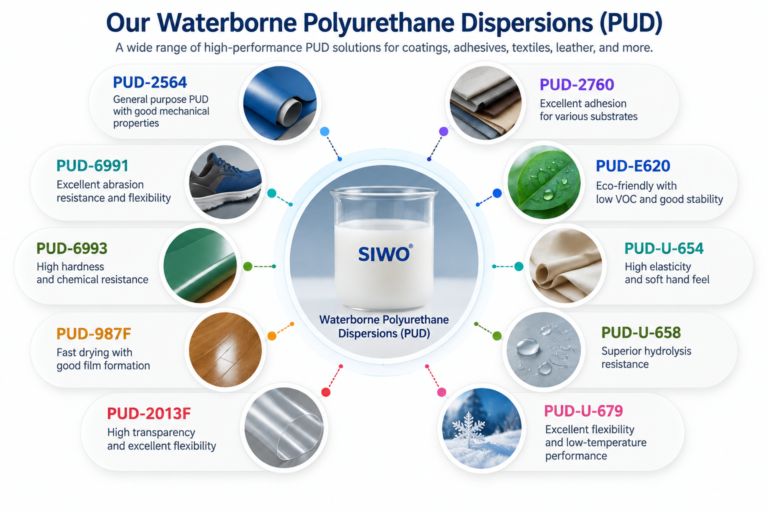
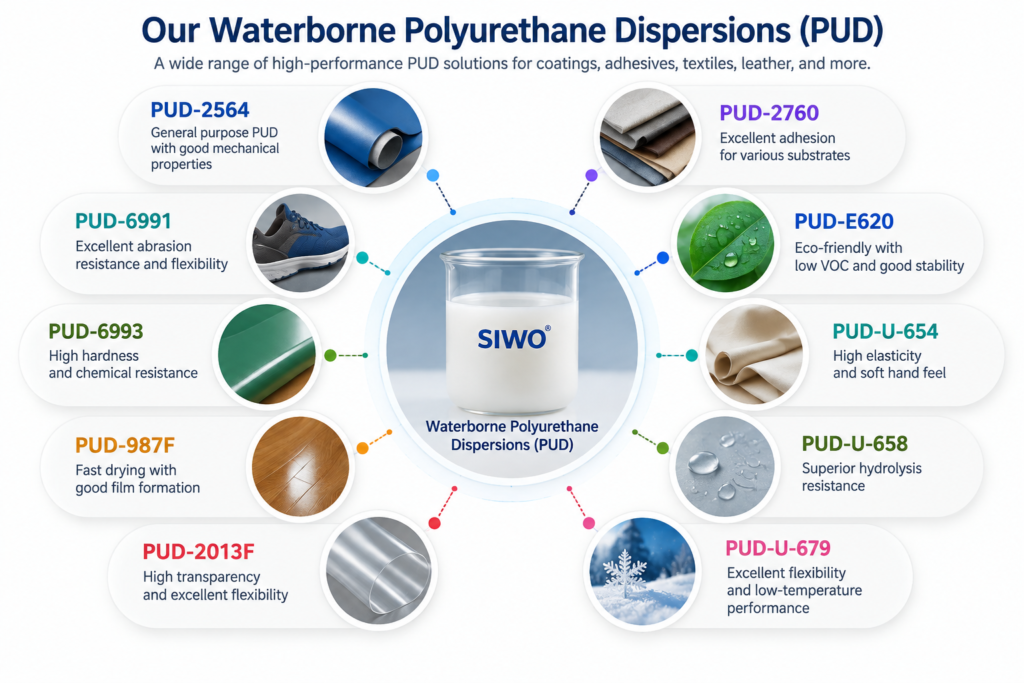
At SIWO US, we provide high-solids waterborne polyurethanes developed for applications where higher productivity and consistent film build are required. Our systems are used in coating and adhesive formulations where reduced drying time and stable processing are important to production efficiency. We also offer waterborne polyurethane dispersions that support formulation flexibility across industrial applications such as packaging, textiles, and surface coatings. In addition, our waterborne polyurethane coatings are designed for wood, plastic, and metal substrates where balanced mechanical performance is needed.
Get in touch with us now.