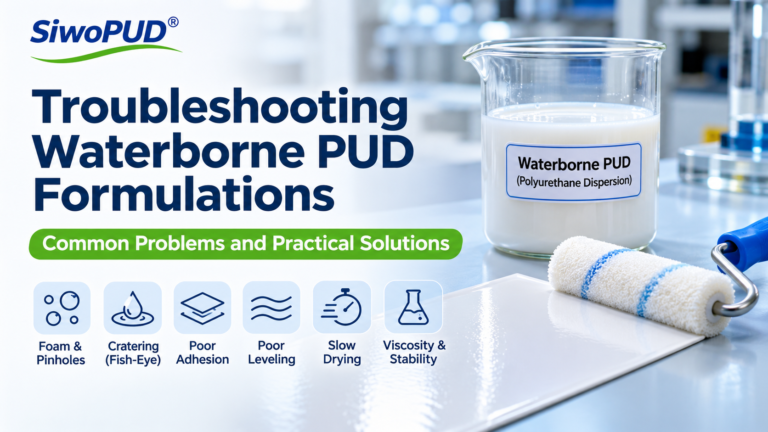
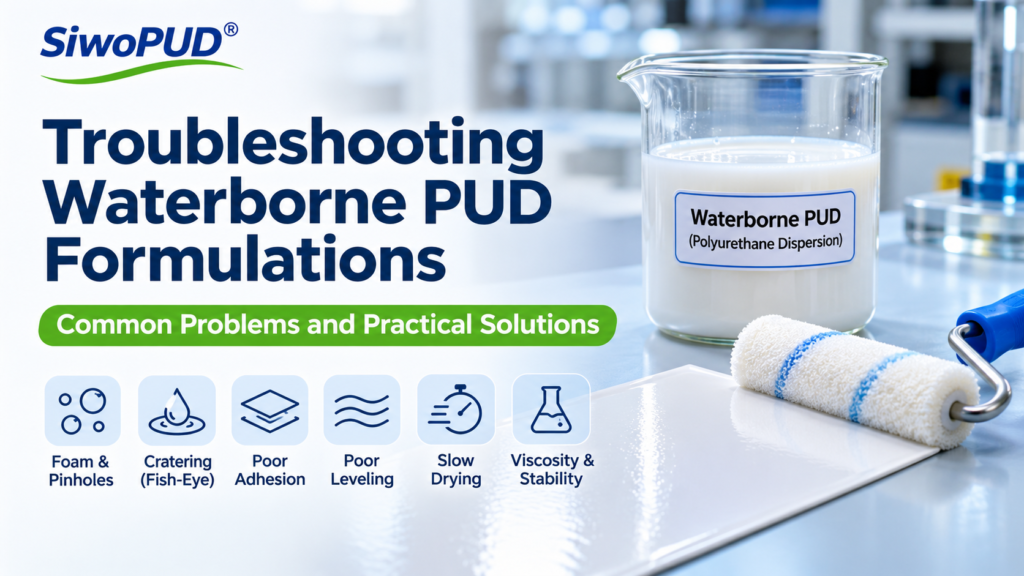
Waterborne PUD troubleshooting starts with understanding how polyurethane dispersion properties, formulation components, and application conditions affect coating performance. However, during formulation and application, coating manufacturers may encounter problems such as foam, pinholes, poor adhesion, cratering, uneven leveling, and storage instability.
These defects do not always originate from the polyurethane dispersion itself. They may also result from additive compatibility, substrate conditions, formulation balance, application methods, or drying conditions.
Understanding the possible causes is the first step toward finding an effective solution. In this guide, we examine common problems in waterborne PUD formulations, explain what may cause them, and outline practical troubleshooting approaches for formulators and coating technicians.
1.Waterborne PUD Troubleshooting: Foam, Bubbles, and Pinholes
Foam formation is a common challenge in waterborne polyurethane dispersion formulations. Air can become trapped during mixing, pumping, or application, resulting in visible bubbles, surface defects, or pinholes in the dried coating film.
Common Causes
- Excessive mixing speed or air entrainment during formulation.
- Incompatible or insufficient defoaming agents.
- High formulation viscosity that prevents trapped air from escaping.
- Excessive wet-film thickness or rapid surface drying.
- Air release from porous substrates during coating application.
Troubleshooting Solutions
- Reduce unnecessary air incorporation during mixing and pumping.
- Evaluate defoamers specifically for compatibility with the PUD formulation.
- Adjust viscosity to support air release without compromising application performance.
- Optimize coating thickness and drying conditions.
- Test the formulation on properly prepared substrates to distinguish formulation-related defects from substrate outgassing.
Adding more defoamer is not always the best solution. Excessive or incompatible defoamer can contribute to surface defects such as cratering. Laboratory trials should be conducted to determine the appropriate additive type and dosage.
2. Cratering and Fish-Eye Defects
Cratering and fish-eye defects appear as small circular depressions or areas where the coating pulls away from the surface. These defects can affect the appearance and uniformity of the finished film.
Common Causes
- Oil, grease, silicone, or other contaminants on the substrate.
- Incompatibility between the PUD and certain formulation additives.
- Poor wetting of the substrate.
- Excessive or incompatible defoamer or leveling-agent dosage.
- Contamination from mixing equipment, containers, or application tools.
Troubleshooting Solutions
- Clean and prepare the substrate before coating.
- Check the compatibility of all additives with the polyurethane dispersion.
- Evaluate wetting agents when the coating does not spread evenly.
- Adjust defoamer and leveling-agent dosage through controlled laboratory testing.
- Keep mixing equipment and containers clean to prevent contamination.
When troubleshooting these defects, first determine whether the problem comes from substrate contamination or formulation incompatibility. Changing several additives at once can make the root cause difficult to identify. Surface wetting and surface tension are important factors in coating appearance and defect prevention.
3. Poor Adhesion to the Substrate
Poor adhesion can cause a waterborne polyurethane coating to peel, flake, or separate from the substrate. This problem may appear immediately after application or become noticeable after drying, water exposure, or mechanical testing.
Common Causes
- Insufficient substrate cleaning or surface preparation.
- Poor wetting of the substrate by the PUD formulation.
- Incompatibility between the selected PUD and the substrate.
- Inadequate film formation under the application and drying conditions.
- Insufficient crosslinking when the formulation requires a curing agent.
Troubleshooting Solutions
- Remove oil, dust, grease, and other contaminants before coating.
- Check whether the selected PUD is suitable for the target substrate.
- Evaluate wetting agents or surface-treatment methods when necessary.
- Review drying conditions and confirm that the film has sufficient time to form.
- If a crosslinker is used, verify its compatibility, dosage, and mixing procedure.
Adhesion should be evaluated on the actual target substrate rather than relying only on tests performed on laboratory glass or standard test panels.
4. Poor Leveling and Orange Peel
Poor leveling occurs when a coating does not spread smoothly across the substrate. Orange peel is a surface appearance defect characterized by an uneven texture resembling the surface of an orange.
These defects can affect the appearance and uniformity of the final coating.
Common Causes
- Formulation viscosity that is too high.
- Poor wetting or leveling properties.
- Incorrect application thickness.
- Unsuitable application techniques or equipment settings.
- Drying conditions that cause the surface to lose flow before leveling is complete.
Troubleshooting Solutions
- Review the formulation viscosity and adjust it when necessary.
- Evaluate compatible wetting and leveling additives.
- Optimize wet-film thickness and application conditions.
- Check spray pressure, nozzle selection, and application distance when spray coating.
- Adjust drying temperature and airflow to allow sufficient time for the coating to level.
A good balance between viscosity, wetting, and drying behavior is important for achieving a smooth and uniform film.
5. Slow Drying and Incomplete Film Formation
Waterborne PUD coatings rely on water evaporation and particle coalescence to form a continuous film. When drying is too slow or film formation is incomplete, the coating may remain tacky, develop poor mechanical properties, or show inconsistent performance.
Common Causes
- Low ambient temperature.
- High relative humidity and insufficient airflow.
- Excessive wet-film thickness.
- Poor drying conditions for the selected PUD.
- Formulation components that affect water evaporation or film formation.
Troubleshooting Solutions
- Maintain suitable temperature and ventilation during drying.
- Control relative humidity and avoid applying coatings under unsuitable environmental conditions.
- Adjust wet-film thickness to support more uniform drying.
- Review the PUD’s technical data sheet for recommended drying conditions.
- Allow sufficient drying time before evaluating final film properties.
Drying performance depends on the PUD chemistry, formulation, substrate, film thickness, and environmental conditions. Always evaluate the coating under conditions representative of the intended production process.
6. Viscosity Changes and Formulation Instability
Changes in viscosity or formulation stability can create problems during storage, handling, and coating application. A PUD formulation may become thicker, thinner, develop sediment, or show signs of separation over time.
Common Causes
- Incompatibility between the PUD and added formulation components.
- Incorrect additive dosage or order of addition.
- Changes in pH that affect dispersion stability.
- Excessive mechanical stress during mixing.
- Storage under unsuitable temperature conditions.
- Microbial contamination in formulations that are not adequately protected.
Troubleshooting Solutions
- Check the pH and viscosity against the original formulation specifications.
- Review the compatibility of each additive with the selected PUD.
- Follow the recommended mixing sequence and avoid unnecessary high-speed mixing.
- Store the dispersion in tightly sealed containers under the temperature conditions specified in its technical data sheet.
- Check for contamination and follow appropriate preservation procedures.
Always consult the specific PUD supplier’s technical data sheet for storage requirements and shelf life. Different polyurethane dispersions may have different stability characteristics.
7.Waterborne PUD Troubleshooting: A Systematic Approach
When a coating defect occurs, changing several formulation components at once can make it difficult to identify the real cause. A systematic troubleshooting process helps formulators isolate problems and develop reliable solutions. Effective waterborne PUD troubleshooting begins with identifying the source of the defect before making formulation changes.
Use the following checklist:
- Identify the defect: Record whether the problem involves foam, pinholes, cratering, poor adhesion, leveling, drying, or storage stability.
- Check the raw materials: Confirm the PUD grade, additive types, dosage, and material condition.
- Review the formulation process: Record the mixing speed, mixing time, order of addition, and any unusual processing conditions.
- Inspect the substrate: Check surface cleanliness, preparation, and compatibility with the coating.
- Record application conditions: Document wet-film thickness, application method, temperature, humidity, and airflow.
- Test one variable at a time: Make controlled adjustments rather than changing multiple ingredients simultaneously.
- Evaluate the final film: Allow sufficient drying or curing time before comparing coating performance.
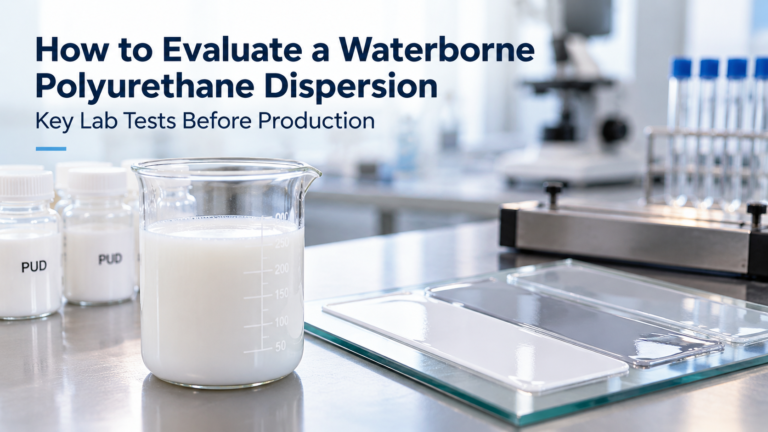
For reliable results, prepare laboratory drawdowns using consistent conditions and compare each trial against the original formulation. Keep detailed records of pH, viscosity, solids content, and application conditions whenever possible.
Conclusion
Troubleshooting waterborne polyurethane dispersion formulations requires a systematic understanding of the relationship between resin properties, additives, substrates, application methods, and drying conditions.
Foam, pinholes, cratering, poor adhesion, uneven leveling, slow drying, and storage instability can have multiple causes. Rather than changing the formulation randomly, coating manufacturers should identify the defect, investigate potential causes, and conduct controlled laboratory trials.
By following a consistent troubleshooting process and consulting the technical data sheet for the selected PUD, formulators can improve coating consistency, reduce production problems, and achieve more reliable application results.