Battery cathode coatings are an important part of lithium-ion battery manufacturing. As the battery industry continues to develop higher-performance energy storage systems, manufacturers are exploring new materials and processing methods. Waterborne polyurethane (WPU) is one material being investigated for battery-related coating and electrode applications.
However, using a waterborne polymer in lithium-ion battery electrodes requires more than good film formation. Material selection must account for electrode chemistry, moisture sensitivity, electrochemical stability, and compatibility with the complete electrode formulation.
This article examines the potential role of waterborne polyurethane in battery cathode coating applications and the key considerations involved in evaluating these materials.
1. Understanding the Role of Polymer Materials in Battery Cathodes
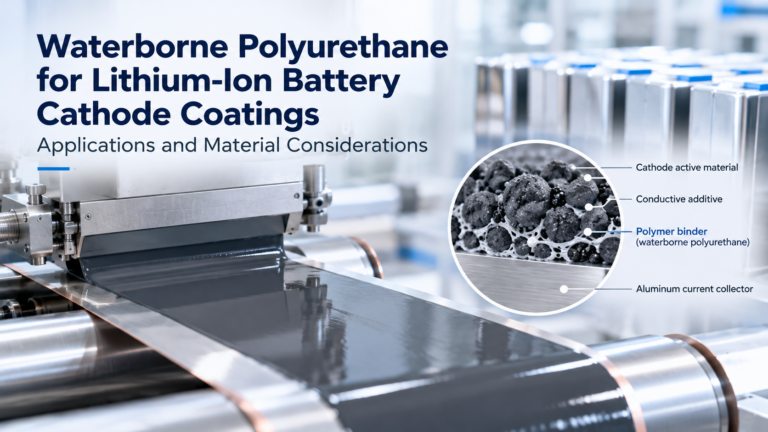
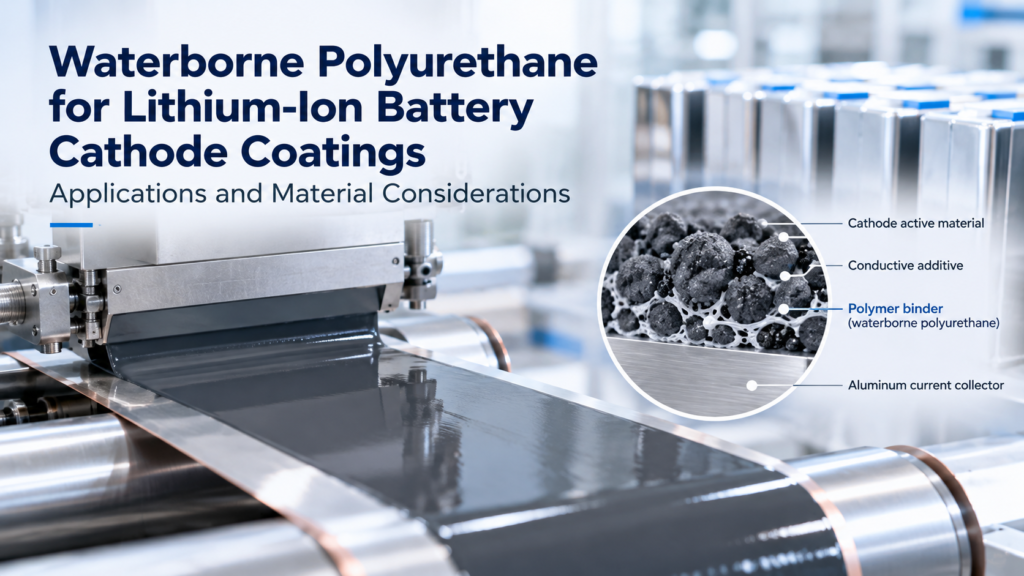
A lithium-ion battery cathode is a composite electrode rather than a single material. It typically contains:
- Active material: Stores and releases lithium ions during charging and discharging.
- Conductive additives: Help establish an electronic conduction network.
- Binder: Holds the electrode components together and helps maintain contact with the current collector.
- Current collector: Provides a conductive support, commonly aluminum foil for cathodes.
Although the binder represents a relatively small portion of the electrode, its properties can influence adhesion, mechanical integrity, particle distribution, and electrode durability.
Polymer binders must maintain sufficient cohesion within the electrode while adhering to the active material particles and current collector. They must also tolerate the chemical and mechanical conditions encountered during battery operation.
Conventional cathode manufacturing commonly uses polyvinylidene fluoride (PVDF) binders with N-methyl-2-pyrrolidone (NMP) as a processing solvent. This has encouraged research into alternative binder systems, including water-based materials.
2. Battery Cathode Coatings and Water-Based Processing
Water-based electrode processing is being studied as a potential approach to reduce dependence on organic processing solvents.
Waterborne polymer dispersions introduce polymer particles into an aqueous medium rather than relying on a conventional solvent-based polymer solution. After application and drying, the polymer particles can form a continuous film or network, depending on the polymer chemistry and processing conditions.
Potential areas of interest include:
- Reducing the use of certain organic processing solvents.
- Developing alternative electrode binder systems.
- Adjusting adhesion and mechanical flexibility through polymer design.
- Exploring water-based processing for different electrode chemistries.
However, water-based processing is not automatically suitable for every cathode material. Some cathode active materials can react with water, potentially causing lithium leaching, changes in slurry pH, and corrosion of aluminum current collectors.
Therefore, the compatibility of the complete aqueous formulation with the selected cathode chemistry must be established through testing.
For more information, explore battery research and development at the U.S. Department of Energy.
3. How Can Waterborne Polyurethane Contribute?
Waterborne polyurethane offers a flexible polymer platform because its chemical structure can be adjusted to achieve different combinations of mechanical and surface properties.
Several characteristics make WPU interesting for battery-related material development. In battery cathode coatings, these properties may help support the development of alternative polymer binder systems.
Adhesion and Cohesion
Polyurethane chemistry can be designed to provide different levels of adhesion and mechanical strength. These properties are relevant when a polymer needs to maintain contact between electrode particles and the current collector.
The required balance depends on the electrode composition, active material, and manufacturing process.
Flexibility and Mechanical Integrity
Polyurethane dispersions can be formulated with different degrees of flexibility and hardness. This tunability may be useful when developing polymer systems that need to accommodate mechanical stress during electrode processing and battery cycling.
However, flexibility alone does not establish battery suitability. Mechanical properties must be evaluated in the finished electrode and under relevant operating conditions.
Film Formation
Waterborne polyurethane dispersions form films as water evaporates and polymer particles consolidate.
The drying and film-formation process can influence the final polymer structure, coating uniformity, and adhesion. For battery applications, the process must also control residual moisture before cell assembly.
Formulation Flexibility
Different polyurethane chemistries can provide different performance profiles. Polyol selection, hard-segment structure, ionic groups, and crosslinking approaches can influence the properties of the resulting polymer.
This creates opportunities for application-specific material development rather than relying on a single universal formulation.
4. Key Challenges in Battery Cathode Coatings
Despite the potential advantages of aqueous polymer systems, cathode applications involve several technical challenges.
Moisture Sensitivity
One of the most important considerations is water exposure. Certain cathode active materials are sensitive to moisture, and aqueous processing can cause unwanted surface reactions or lithium loss.
The formulation, mixing conditions, processing time, and drying process must therefore be carefully evaluated.
Aluminum Current Collector Compatibility
Aluminum foil is widely used as a cathode current collector. Aqueous slurries with unsuitable pH or chemical composition may cause aluminum corrosion.
The interaction between the binder, other slurry ingredients, and aluminum substrate should be tested before production-scale implementation.
Electrolyte Compatibility
A polymer binder must remain sufficiently stable in contact with the battery electrolyte.
Important evaluation areas include electrolyte absorption, swelling, adhesion retention, and changes in mechanical properties after electrolyte exposure.
A polymer that performs well in a dry film test may behave differently after contact with the electrolyte.
Electrochemical Stability
Battery materials operate within defined voltage ranges. A candidate polymer must be evaluated for electrochemical compatibility under the intended operating conditions.
Electrochemical stability cannot be established from ordinary coating properties such as tensile strength, elongation, or water resistance alone.
Drying and Residual Moisture
Residual water is a critical consideration in battery manufacturing. The drying process must remove moisture to a level appropriate for the intended battery system.
Drying temperature, time, coating thickness, and polymer film formation can all influence the final result.
5. What Should Be Evaluated When Selecting a Waterborne Polyurethane?
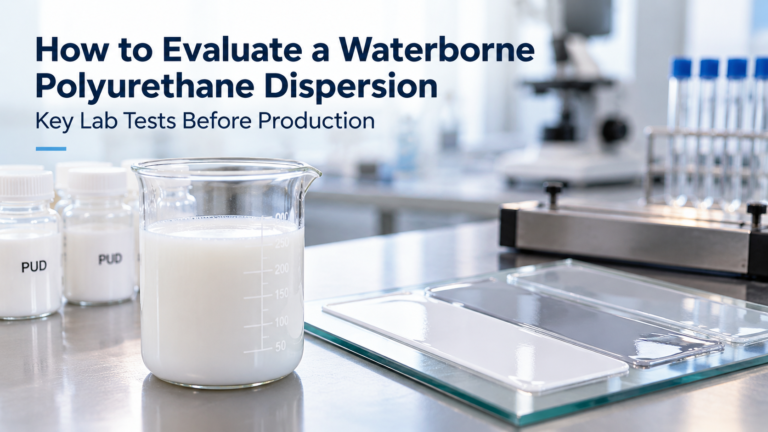
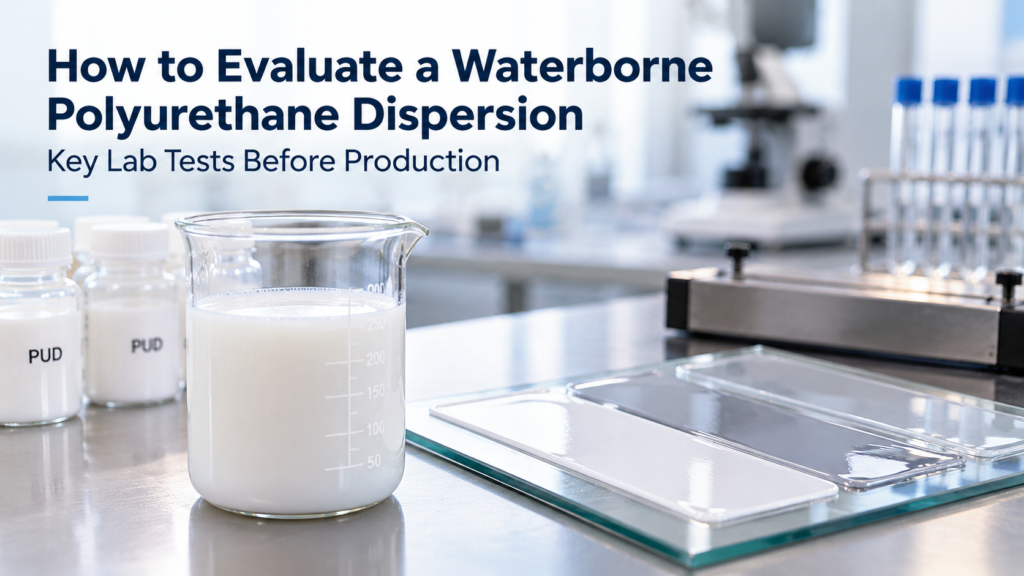
Before considering a waterborne polyurethane for battery-related applications, formulators should evaluate both its basic dispersion properties and its performance in the actual electrode system.
The following areas provide a practical starting point.
| Evaluation area | What to examine |
|---|---|
| Dispersion stability | Storage stability, particle size, pH, and viscosity |
| Slurry compatibility | Compatibility with active materials and conductive additives |
| Coating behavior | Uniformity, coatability, and processing consistency |
| Adhesion | Bonding to electrode components and current collector |
| Mechanical properties | Cohesion, flexibility, and resistance to cracking |
| Moisture management | Drying behavior and residual moisture |
| Electrolyte resistance | Swelling, adhesion retention, and mechanical stability |
| Electrochemical performance | Stability under the intended voltage and cycling conditions |
These tests should be conducted in stages. Initial polymer screening can identify promising candidates, but final suitability must be determined using representative electrode formulations and battery testing.
6. Waterborne Polyurethane Is Not a Universal Battery Binder
An important distinction is that not every waterborne polyurethane dispersion is suitable for battery electrode manufacturing.
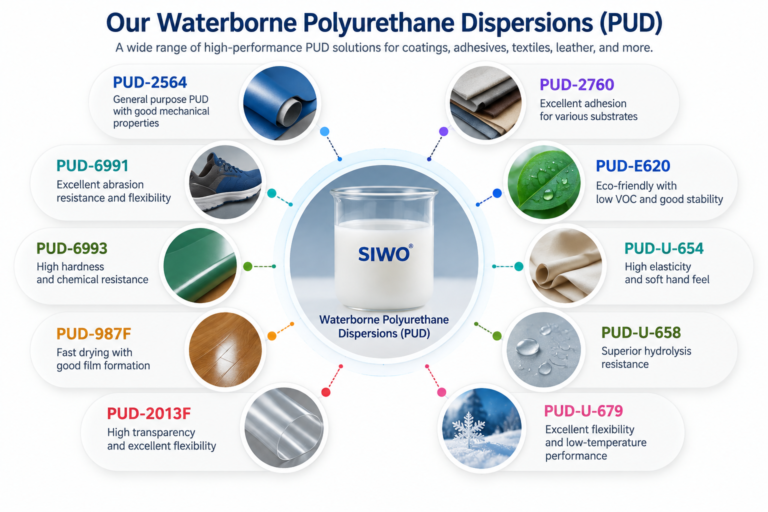
PUDs are developed for different applications, and their properties vary according to their chemical composition and formulation. A dispersion designed for coatings, adhesives, textiles, or packaging should not automatically be considered appropriate for cathode applications.
Battery-specific evaluation is necessary to determine whether a particular polymer meets the requirements for:
- The selected cathode chemistry.
- The intended slurry formulation.
- The electrode coating and drying process.
- Electrolyte exposure.
- Electrochemical operating conditions.
The same principle applies when comparing waterborne polyurethane with other aqueous binder systems. Material selection should be based on application-specific testing rather than a general assumption that one polymer chemistry will outperform another.
7. The Future of Waterborne Polyurethane in Battery Materials
Research into waterborne polyurethane and polyurethane-urea systems for rechargeable batteries continues to expand. Recent studies have examined their potential roles in electrode binders, separator coatings, functional interlayers, and polymer electrolyte systems.
These developments demonstrate that polyurethane chemistry offers a range of possibilities for battery material research. At the same time, practical adoption depends on resolving challenges involving adhesion, electrolyte uptake, moisture control, and electrochemical stability.
For manufacturers and material developers, the most important step is to connect polymer design with the requirements of a specific battery component and manufacturing process.
Conclusion
Waterborne polyurethane represents an interesting material platform for the development of water-based battery coating and electrode-related technologies. Its adjustable chemistry and film-forming characteristics provide opportunities to investigate adhesion, flexibility, and mechanical integrity in battery material systems.
However, cathode applications require careful attention to moisture sensitivity, aluminum compatibility, electrolyte resistance, and electrochemical stability. Standard coating performance data alone cannot establish whether a PUD is suitable for battery manufacturing.
Successful material selection requires systematic testing using the intended electrode chemistry and processing conditions.
SIWO develops waterborne polyurethane dispersions for a range of industrial applications, including cathode coating for new-energy batteries. If you are evaluating polyurethane dispersions for a battery-related application, contact our team to discuss your material requirements and testing needs.
Note: Battery suitability is application-specific. Product selection and performance should be confirmed through technical evaluation and testing. The mention of cathode coating as an application does not imply that every SIWO PUD grade is suitable for this use.