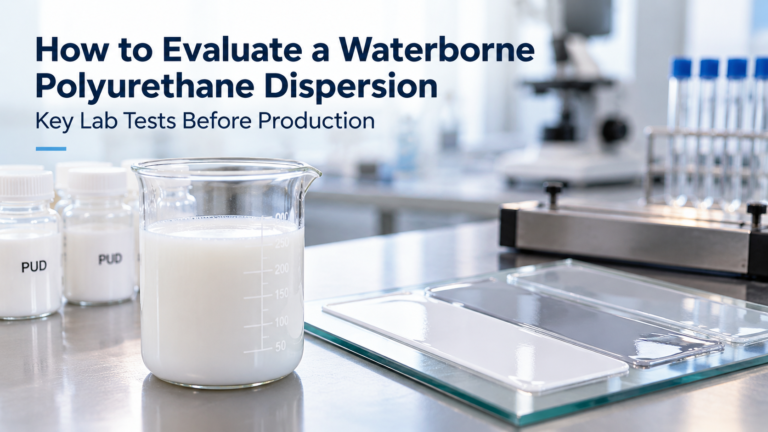
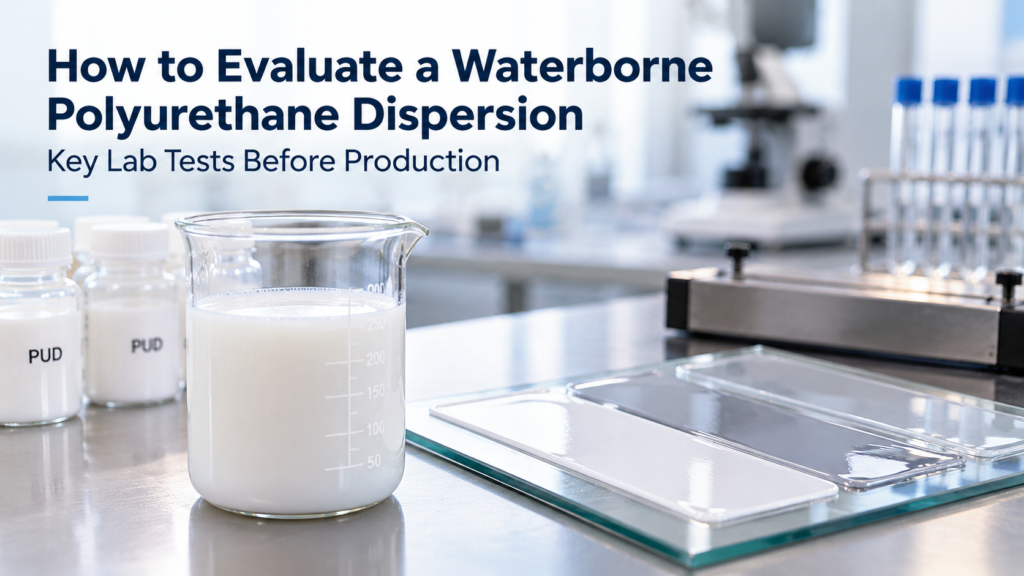
Waterborne polyurethane dispersion testing is an important step in evaluating a resin before adopting it for a coating, adhesive, or other formulation. Rather than comparing price and appearance alone, formulators should assess basic properties, processing behavior, and performance in the intended application.
A structured laboratory evaluation helps identify potential compatibility issues, establish a baseline for comparison, and determine whether a material is suitable for further development or production trials.
In this guide, we explain the key checks to consider when evaluating a waterborne polyurethane dispersion and how to organize the results before making a material-selection decision.
Check the Basic Properties of the PUD
Start by reviewing the technical data sheet (TDS) and confirming that the sample matches the grade and specifications supplied by the manufacturer. Basic properties provide a useful starting point for comparing different waterborne polyurethane dispersions.
For additional background, see the U.S. EPA’s technical resources on polyurethane coatings.
The following checks are commonly useful:
- Appearance: Observe the dispersion for uniformity, unusual discoloration, visible particles, or signs of separation.
- Solid content: Measure the nonvolatile content using an appropriate laboratory method. This helps establish how much nonvolatile material the dispersion contains.
- pH: Measure pH with a suitable, calibrated pH meter. Changes in pH may affect stability or compatibility, depending on the formulation.
- Viscosity: Measure viscosity under consistent conditions, including temperature and test method, so results can be compared meaningfully.
- Particle size, when relevant: Particle-size data can help characterize a dispersion, particularly when investigating differences in appearance, stability, or application behavior.
Record the test method, temperature, instrument, and results for each sample. Use the manufacturer’s specifications and an agreed testing procedure as the basis for evaluating whether the results are acceptable.
Evaluate Film Performance in Waterborne Polyurethane Dispersion Testing
A waterborne polyurethane dispersion is often selected for the properties it delivers after drying and film formation. However, the performance of the dried film depends on the polymer chemistry, formulation, substrate, drying conditions, and intended application. Waterborne polyurethane dispersion testing should reflect the performance requirements of the intended application.
To evaluate film formation, prepare samples using a consistent procedure. Keep the substrate, applied thickness, drying temperature, and conditioning time as similar as possible when comparing different dispersions.
Consider the following checks:
- Film appearance: Look for visible defects such as pinholes, bubbles, cracks, unevenness, or whitening.
- Film continuity: Check whether the dried coating forms a continuous film under the selected application and drying conditions.
- Adhesion: Evaluate adhesion on the intended substrate using a suitable test method.
- Flexibility: Where relevant, assess whether the film can tolerate the bending or deformation expected in service.
- Water resistance: If water exposure matters for the application, evaluate the film using a defined water-contact procedure and compare the results after consistent conditioning.
No single test determines whether a PUD is suitable for every application. Establish acceptance criteria based on the end use and compare results using consistent test methods.
A PUD that performs well in an initial film test may still present challenges when stored or incorporated into a formulation. Stability and compatibility checks help determine whether the dispersion behaves consistently under the conditions expected during development and use.
Storage stability
Observe the sample for changes in appearance, sedimentation, separation, skin formation, or other visible changes. If storage stability is important, record the storage conditions and inspection dates. Accelerated aging tests may provide additional information, but their results should not automatically be treated as equivalent to long-term storage performance.
Mechanical and formulation compatibility
If the PUD will be combined with pigments, additives, crosslinkers, or other binders, evaluate compatibility through controlled laboratory trials. Add materials gradually according to an established procedure and observe whether the mixture develops coagulation, excessive viscosity changes, separation, or other unexpected behavior.
Application behavior
Check whether the formulation can be mixed, applied, and dried using the intended process. Depending on the application, relevant observations may include foaming, leveling, wetting, drying behavior, and film uniformity.
Compatibility depends on the specific materials, proportions, mixing sequence, and processing conditions. Test the complete formulation rather than assuming that a dispersion will be compatible with every additive or binder.
Compare Waterborne Polyurethane Dispersion Testing Results
Testing is most useful when results can be compared consistently. When evaluating several waterborne polyurethane dispersions, use the same test procedures and record the results in a structured format. Consistent waterborne polyurethane dispersion testing makes comparisons between candidate materials more meaningful.
A comparison sheet can include:
- Sample identification: Manufacturer, product grade, batch number, and date received.
- Basic properties: Appearance, solid content, pH, and viscosity.
- Film performance: Film appearance and any application-specific results, such as adhesion, flexibility, or water resistance.
- Formulation behavior: Compatibility observations, mixing conditions, and any processing issues.
- Test conditions: Equipment, method, temperature, drying conditions, and conditioning time.
Compare the results with the technical data sheet and your application’s requirements. If a result differs from the expected range, repeat the measurement where appropriate and investigate possible causes before drawing conclusions.
A documented evaluation provides a clearer basis for deciding whether a sample should proceed to further formulation work, pilot testing, or production trials.
Make an Informed PUD Selection
Evaluating a waterborne polyurethane dispersion requires more than checking a single specification. Basic properties, film formation, application performance, storage stability, and formulation compatibility all contribute to understanding whether a material is suitable for a particular use.
For the most meaningful comparison, use consistent test procedures, document the conditions, and assess results against the requirements of the intended application. Laboratory screening can help narrow down candidates before more extensive formulation development and production trials.
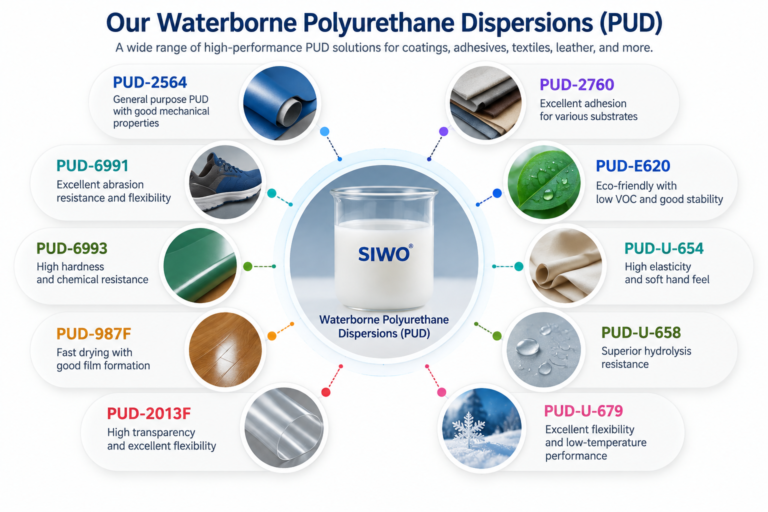
At SIWO, we supply waterborne polyurethane dispersions for industrial formulation and coating applications. If you are evaluating a PUD for a specific application, contact our team to discuss your requirements and identify a suitable grade for further testing.