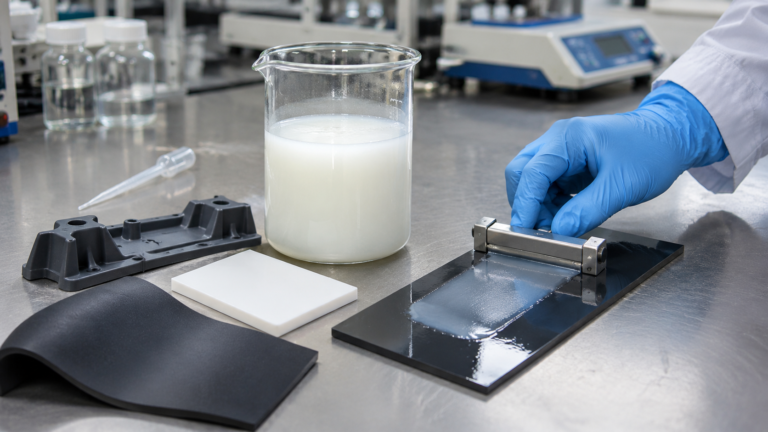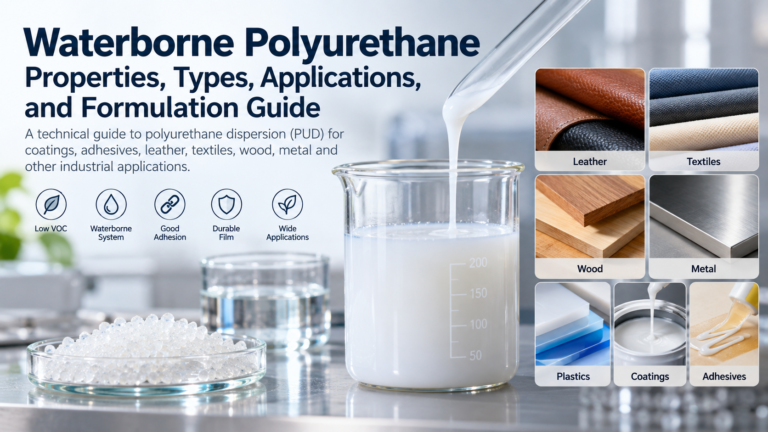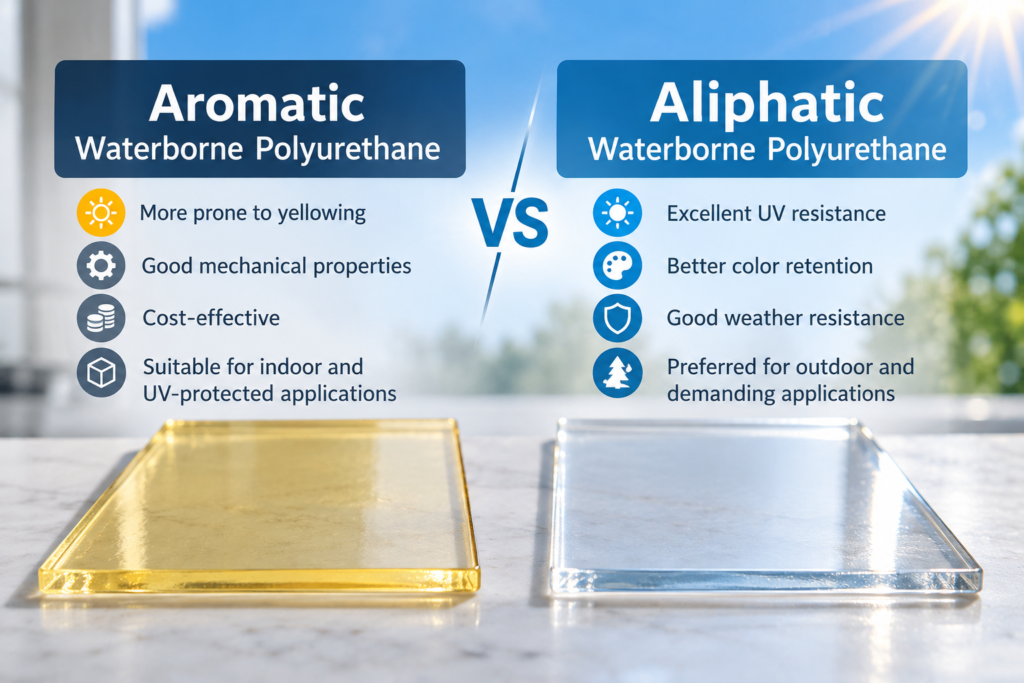
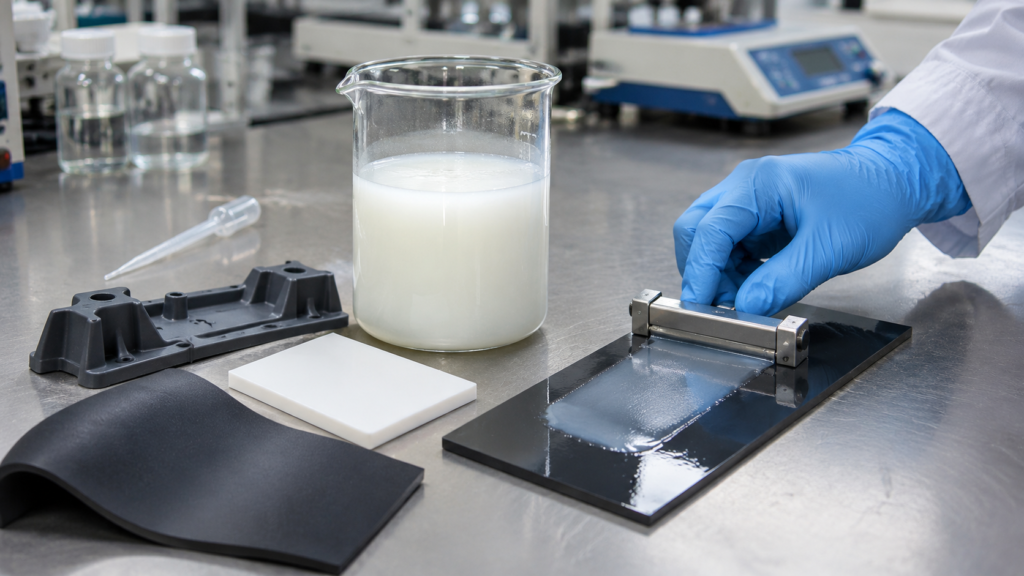
Waterborne polyurethane for plastic coatings offers formulators a water-based option for improving the surface performance of plastic and rubber substrates. Selecting the right polyurethane dispersion (PUD) requires careful consideration of substrate compatibility, adhesion, flexibility, water resistance, and formulation requirements.
Waterborne polyurethane (PUD) coatings provide formulators with options for developing coatings for selected plastic and rubber substrates. Depending on the polyurethane chemistry and formulation, these coatings can offer adhesion, flexibility, water resistance, abrasion resistance, and surface durability.
Choosing the right polyurethane dispersion requires more than comparing product specifications. The substrate, surface preparation, application method, drying conditions, and required coating properties must all be considered.
This guide explains the key factors involved in selecting and formulating waterborne polyurethane coatings for plastic and rubber applications.
1. Why Is Adhesion Important for Plastic and Rubber Coatings?
Adhesion is one of the most important requirements in plastic and rubber coating applications. Even a coating with excellent surface properties will not perform as expected if it cannot bond reliably to the substrate.
Unlike many metal or wood surfaces, plastics and rubber materials can have relatively low surface energy or contain substances that interfere with coating adhesion.
For additional information about polyurethane materials and applications, see the American Chemistry Council’s polyurethane resources.
Different Substrates Have Different Surface Characteristics
Plastic and rubber are broad material categories. Their surface properties vary considerably depending on the polymer type, manufacturing process, additives, and surface treatment.
For example:
- Polypropylene (PP) and polyethylene (PE) are generally difficult to coat because of their low surface energy.
- Polyvinyl chloride (PVC) may contain plasticizers that can influence coating compatibility.
- Polycarbonate (PC) and other engineering plastics require evaluation of coating compatibility and application conditions.
- Rubber substrates may contain mold-release agents, oils, or other processing residues that affect adhesion.
A polyurethane dispersion suitable for one substrate should not automatically be assumed to work on another.
Surface Preparation and Treatment
Proper surface preparation helps create more consistent coating conditions.
Before applying a PUD coating, consider:
- Removing dust, oil, grease, and other contaminants.
- Checking for mold-release agents and processing residues.
- Ensuring the substrate is clean and dry.
- Evaluating whether additional surface treatment is necessary.
For difficult-to-coat plastics, methods such as corona treatment, plasma treatment, or other suitable surface treatments may improve wettability and adhesion.
The effectiveness of each treatment should be verified on the actual substrate.
2. Important Properties of Waterborne Polyurethane for Plastic and Rubber
The required coating properties depend on the final application. A coating for a rigid plastic component may require different characteristics from one used on a flexible rubber product.
Adhesion
Good adhesion helps prevent peeling, flaking, and coating separation during handling and service.
When evaluating a PUD, test adhesion on the actual substrate rather than relying only on general product descriptions.
Surface preparation, coating thickness, drying conditions, and formulation compatibility can all affect the result.
Flexibility and Elasticity
Rubber and flexible plastic components may undergo bending, stretching, or repeated deformation.
A suitable polyurethane coating should maintain its integrity under the movement expected during use.
The balance between hardness and flexibility is important. A coating that is too hard may crack when applied to a highly flexible substrate, while a coating that is too soft may not provide the desired surface durability.
Water Resistance
Water resistance is important for products exposed to moisture, washing, or humid environments.
The performance of a PUD coating depends on its polymer chemistry, film formation, additives, and drying or curing conditions.
Water resistance should be evaluated after the coating has received sufficient drying or curing time.
Abrasion Resistance
Plastic and rubber components may experience friction, repeated contact, and handling.
A polyurethane coating can be selected or formulated to provide the required abrasion resistance.
Testing should reflect the actual use conditions and the level of surface wear expected.
Chemical Resistance
Some coated products may encounter oils, cleaning agents, alcohols, or other chemicals.
The coating should be evaluated against the specific chemicals and exposure conditions relevant to the application. General chemical-resistance descriptions do not guarantee resistance to every chemical.
3. How to Select the Right Waterborne Polyurethane Dispersion
Selecting a suitable PUD starts with understanding the substrate and the final coating requirements.
Identify the Substrate
First, determine the exact material being coated.
Examples include:
- Polypropylene (PP).
- Polyethylene (PE).
- Polyvinyl chloride (PVC).
- Polycarbonate (PC).
- Other engineering plastics.
- Natural or synthetic rubber.
If the material contains surface treatments, plasticizers, release agents, or other additives, these should also be considered.
Define the Required Film Properties
Before choosing a PUD, identify the most important coating requirements.
| Requirement | What to evaluate |
|---|---|
| Adhesion | Bonding to the specific plastic or rubber substrate |
| Flexibility | Resistance to cracking during bending or deformation |
| Hardness | Surface hardness required for the finished product |
| Water resistance | Performance after water exposure |
| Abrasion resistance | Resistance to friction and repeated contact |
| Chemical resistance | Resistance to relevant chemicals and cleaning agents |
| Appearance | Gloss, transparency, smoothness, and film uniformity |
Not every application requires the same combination of properties. Prioritize the requirements that matter most to the finished product.
Compare PUD Chemistry and Technical Data
Polyurethane dispersions are available in different chemical structures, including polyester, polyether, and polycarbonate-based systems.
These chemistries can influence properties such as flexibility, hardness, water resistance, and durability.
However, chemistry alone does not determine final performance. Two PUDs with similar chemical classifications may have different characteristics because of differences in polymer design and formulation.
Review the technical data sheet and evaluate the product under the intended application conditions.
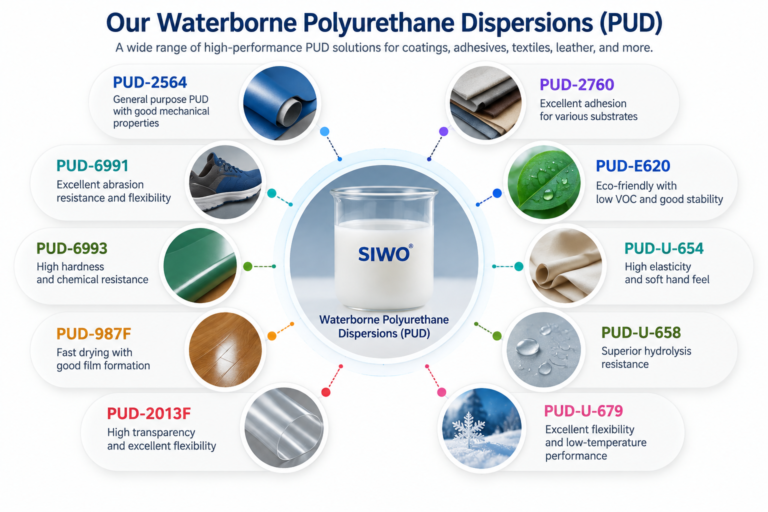
4. Waterborne Polyurethane for Plastic Coatings: SIWO Product Selection
SIWO’s 2026 product catalogue identifies several polyurethane dispersions with applications relevant to plastic, rubber, and film substrates.
The following products can serve as starting points for technical evaluation.
SiwoPUD®-994F: For Plastic and Rubber Substrates
PUD-994F is an aliphatic polycarbonate polyurethane dispersion with 35±1% solid content.
According to the SIWO catalogue, it offers:
- Excellent water resistance.
- Excellent adhesion.
- Abrasion resistance.
- Weather resistance.
- Hydrolysis resistance.
Its listed applications include leather, paper, rubber, and plastic substrates, as well as architectural and industrial coatings.
For formulators evaluating a PUD for plastic or rubber coatings, PUD-994F is one product worth considering based on its listed substrate applications.
SiwoPUD®-920F: For Plastic Coatings
PUD-920F is an aliphatic polyester-carbonate polyurethane dispersion with 35±1% solid content.
Its listed properties include:
- Excellent water resistance.
- Alkali resistance.
- Hydrolysis resistance.
- High film hardness.
- Good wear resistance.
- Chemical resistance.
The SIWO catalogue lists plastic coatings, wood coatings, floor coatings, and acrylic emulsion modification among its applications.
It may be worth evaluating when a plastic coating requires a harder film and the listed resistance properties.
SiwoPUD®-E620: For Rubber and Film Substrates
PUD-E620 is an aliphatic polycarbonate polyurethane dispersion with 40±1% solid content.
Its listed characteristics include:
- Medium film hardness.
- Excellent water resistance.
- Excellent abrasion resistance.
- Excellent lightfastness.
- Excellent hydrolysis resistance.
Its listed applications include leather, rubber, and film substrates.
The catalogue also notes that the dispersion can be diluted with 80% industrial alcohol and has good storage stability. Formulators should verify compatibility and handling requirements before incorporating alcohol into a formulation.
Comparing the Three Products
| Product | Chemistry | Solid content | Listed relevant applications |
|---|---|---|---|
| PUD-994F | Aliphatic polycarbonate | 35±1% | Rubber and plastic substrates |
| PUD-920F | Aliphatic polyester-carbonate | 35±1% | Plastic coatings |
| PUD-E620 | Aliphatic polycarbonate | 40±1% | Rubber and film substrates |
These products are not interchangeable. The best starting point depends on the substrate, required film properties, formulation compatibility, and processing conditions.
The listed applications are a basis for evaluation, not a guarantee of performance on every grade of plastic or rubber.
5. Formulation Considerations for Plastic and Rubber Coatings
Selecting the appropriate PUD is only one part of developing a successful coating. Formulation design and application conditions also influence the final result.
Additive Selection
Depending on the application, a PUD formulation may require additional additives to improve application behavior and coating performance.
Common additive categories include:
- Wetting agents: Help improve wetting of the substrate.
- Defoamers: Help control foam during mixing and application.
- Leveling agents: Help improve surface smoothness and appearance.
- Thickeners: Adjust viscosity to suit the application method.
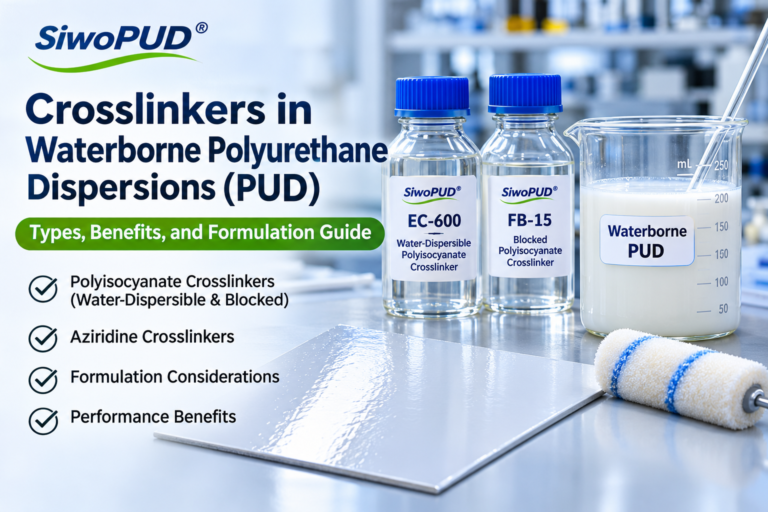
- Crosslinkers: May be considered when additional film performance is required and the PUD is chemically compatible.
The correct additive selection and dosage depend on the specific PUD and formulation.
Adding too much of an additive or using an incompatible material may cause problems such as poor adhesion, surface defects, viscosity changes, or dispersion instability.
Viscosity and Application Method
Viscosity affects coating flow, leveling, and application behavior.
The appropriate viscosity depends on the coating equipment and production process.
Common application methods include:
- Spray coating.
- Roller coating.
- Brush coating.
- Other industrial coating methods.
The formulation should be adjusted according to the substrate geometry, application equipment, and desired wet-film thickness.
Drying and Film Formation
Waterborne polyurethane coatings require suitable conditions for water evaporation and film formation.
Important factors include:
- Temperature.
- Relative humidity.
- Air circulation.
- Wet-film thickness.
- Substrate temperature.
- Drying time.
Insufficient drying may affect adhesion, appearance, and resistance properties. Drying conditions should be established through laboratory trials before production.
Crosslinking Considerations
For applications requiring improved resistance or durability, a compatible crosslinker may be considered.
However, crosslinkers are not necessary for every PUD formulation. Their use depends on the polymer chemistry, available functional groups, desired performance, and processing conditions.
Compatibility, addition ratio, mixing procedure, pot life, and curing requirements should be evaluated before introducing a crosslinker into production.
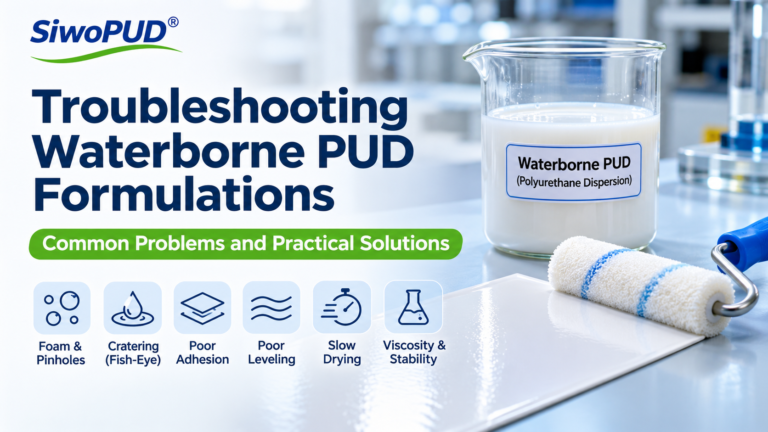
6. Common Challenges and How to Evaluate Them
During coating development, several problems may occur. A systematic troubleshooting approach helps identify their possible causes.
| Observed problem | Possible factors to investigate |
|---|---|
| Poor adhesion | Surface contamination, low surface energy, unsuitable PUD, or insufficient surface treatment |
| Coating cracks | Excessive film hardness, insufficient flexibility, or substrate deformation |
| Poor water resistance | Incomplete film formation, unsuitable PUD chemistry, or insufficient drying |
| Uneven coating | Poor substrate wetting, unsuitable viscosity, or application conditions |
| Bubbles or pinholes | Entrained air, foam, substrate outgassing, or drying conditions |
| Poor abrasion resistance | Film properties, formulation balance, or insufficient curing where applicable |
Do not immediately assume that every coating defect is caused by the PUD itself. The substrate, additives, mixing procedure, application method, and drying conditions may also contribute.
Change one variable at a time during troubleshooting so that the effect of each adjustment can be evaluated.
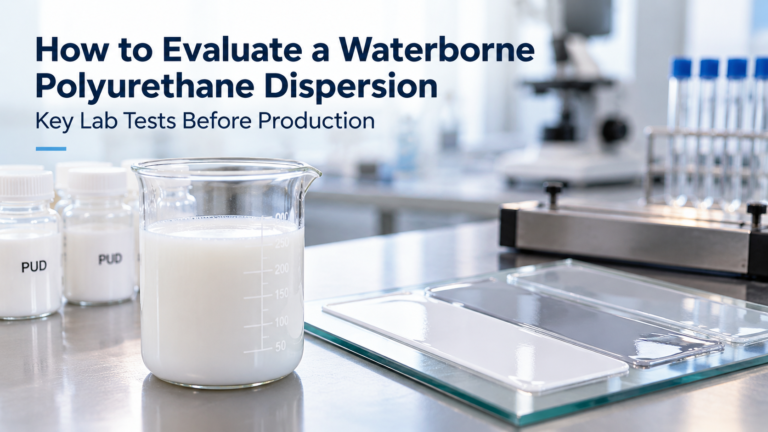
7. Laboratory Testing Before Production
Before selecting a PUD for commercial production, conduct laboratory testing using the actual substrate and intended coating process.
A practical evaluation program may include:
Adhesion Test
Apply the coating to the prepared substrate and evaluate adhesion using an appropriate test method.
Compare results before and after relevant exposure conditions where necessary.
Flexibility Test
For rubber and flexible plastic applications, evaluate whether the coating can withstand bending or deformation without cracking or peeling.
Water Resistance Test
Expose the coated sample to water under controlled conditions. Inspect for whitening, blistering, peeling, or other changes.
Abrasion Test
Evaluate the coating’s resistance to repeated friction or surface contact using a test method appropriate for the application.
Chemical Resistance Test
If the finished product will contact cleaning agents, oils, alcohols, or other chemicals, test resistance against the actual substances and exposure conditions.
Appearance Evaluation
Inspect the finished coating for gloss, transparency, smoothness, leveling, bubbles, pinholes, and other surface defects.
Record the formulation, substrate preparation, application conditions, and drying conditions for every test. This makes it easier to compare different PUD grades and identify the most suitable formulation.
Conclusion
Waterborne polyurethane dispersions offer useful options for developing coatings for selected plastic and rubber substrates. However, successful coating development depends on achieving the right balance between adhesion, flexibility, hardness, water resistance, and surface durability.
Substrate identification and preparation should be the starting points. The PUD should then be selected according to the required coating properties, followed by careful formulation, application, and laboratory testing.
SIWO offers waterborne polyurethane dispersions with listed applications for plastic, rubber, and film substrates, including PUD-994F, PUD-920F, and PUD-E620.
Looking for a suitable waterborne polyurethane dispersion for your plastic or rubber coating application? Contact SIWO to discuss your substrate, performance requirements, and formulation needs.