Crosslinkers in Waterborne Polyurethane Dispersions: Types, Benefits, and Formulation Guide
Waterborne polyurethane crosslinkers are used in PUD formulations to improve selected coating properties, such as water resistance, chemical resistance, and mechanical durability. Depending on the crosslinker chemistry and formulation conditions, they can help create a more interconnected polymer network for demanding applications.
Choosing the right crosslinker requires understanding its chemistry, compatibility with the PUD, addition method, and curing conditions. This guide introduces common crosslinker types and explains the key considerations when incorporating them into waterborne polyurethane formulations.
1. What Are Waterborne Polyurethane Crosslinkers?
A crosslinker is a reactive chemical component that can connect polymer chains through chemical reactions, forming a more interconnected polymer network.
In a waterborne polyurethane formulation, the crosslinker may react with suitable functional groups in the polyurethane dispersion or other formulation components. The resulting network can change the physical and chemical properties of the dried coating film.
The extent of crosslinking depends on several factors, including:
- The chemical structure and functional groups of the PUD.
- The type and functionality of the crosslinker.
- The crosslinker dosage.
- Compatibility between formulation components.
- Mixing and application conditions.
- Temperature and curing time.
Not every PUD requires an additional crosslinker. The decision should be based on the target application and laboratory performance evaluations.
2. Main Types of Crosslinkers for Waterborne PUD Formulations
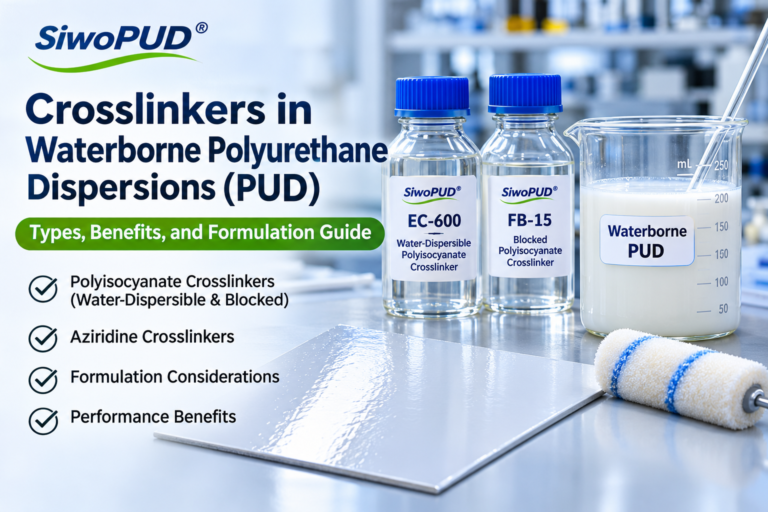
Several crosslinker chemistries can be considered for waterborne polyurethane systems. Two types commonly discussed in PUD formulation are polyisocyanate crosslinkers and aziridine crosslinkers.
For additional technical information, see Covestro’s overview of waterborne coatings and polyurethane crosslinkers.
2.1 Water-Dispersible Polyisocyanate Crosslinkers
Water-dispersible polyisocyanate crosslinkers are used in certain two-component waterborne polyurethane systems.
These products are designed to be incorporated into compatible waterborne formulations. Their reactive isocyanate groups can react with suitable functional groups in the formulation, contributing to the formation of a crosslinked polymer network.
Depending on the PUD chemistry and formulation, polyisocyanate crosslinkers may be used to improve properties such as:
- Water resistance.
- Chemical resistance.
- Mechanical durability.
- Resistance to abrasion.
- Film performance under demanding service conditions.
However, the actual results depend on the compatibility of the crosslinker with the selected PUD and the curing conditions.
Because reactive isocyanate groups can also react with water, formulators need to consider pot life, mixing procedures, and storage after combining the components.
2.2 Blocked Polyisocyanate Crosslinkers
Blocked polyisocyanates are another type of crosslinker used in polyurethane coating systems.
In these products, the isocyanate groups are temporarily blocked by a suitable blocking agent. Under appropriate heating conditions, the blocking agent is released and the isocyanate groups become available for further reaction.
This makes blocked polyisocyanates useful in formulations designed for heat-activated curing.
Important considerations include:
- Deblocking temperature.
- Required curing time.
- Compatibility with the PUD.
- Substrate heat resistance.
- Production-line temperature and processing conditions.
The deblocking temperature is particularly important when selecting a product. The coating process must provide suitable conditions for activation without damaging the substrate or finished material.
2.3 Aziridine Crosslinkers
Aziridine crosslinkers are another chemistry used in certain waterborne polymer formulations.
They can react with suitable functional groups in a polymer system to form a crosslinked network. Their suitability depends on the chemical structure of the PUD and the intended application.
When evaluating an aziridine crosslinker, formulators should consider:
- Compatibility with the selected polymer dispersion.
- Functional-group availability.
- Addition ratio and mixing procedure.
- Pot life and handling requirements.
- Applicable safety and regulatory requirements.
Aziridine crosslinkers should not be treated as interchangeable with polyisocyanate crosslinkers. Their reaction mechanisms, formulation requirements, and handling considerations are different.
3. Potential Benefits of Crosslinking a PUD Film
The purpose of adding a crosslinker is to improve specific properties required by the final application. The benefits should always be confirmed through testing.
Improved Water Resistance
Crosslinking can reduce the ability of water to affect the polymer network, potentially improving the coating’s resistance to water exposure.
The improvement depends on the PUD chemistry, crosslinker selection, and degree of crosslinking.
Improved Chemical Resistance
A more interconnected polymer network may improve resistance to selected chemicals, cleaning agents, or solvents.
The result is application-specific. Testing should use the chemicals and exposure conditions relevant to the intended service environment.
Improved Mechanical Durability
Crosslinking may help improve properties such as abrasion resistance, blocking resistance, and resistance to mechanical damage.
However, excessive crosslinking can also affect flexibility and elongation. Formulators should balance durability with the flexibility required by the application.
Improved Film Performance
Crosslinking can modify the overall film structure and influence several performance characteristics at the same time.
The final result depends on the balance between polymer chemistry, crosslinker functionality, formulation design, and curing conditions.
4. Important Formulation Considerations
Adding a crosslinker is not simply a matter of mixing two products together. Formulation compatibility and processing conditions are important.
Crosslinker Compatibility
Before adding a crosslinker, confirm that it is compatible with the selected PUD.
An incompatible crosslinker may cause problems such as viscosity changes, instability, coagulation, or uneven film formation.
Laboratory compatibility testing should be conducted before moving to larger-scale production.
Addition Ratio
There is no universal crosslinker dosage suitable for every PUD.
The appropriate amount depends on the crosslinker’s functionality, the PUD’s chemical structure, and the desired film properties.
Start with the supplier’s recommended guidance and conduct controlled laboratory trials to determine the appropriate formulation.
Mixing Procedure
The addition sequence and mixing conditions can influence formulation stability.
Follow the technical recommendations for both the PUD and crosslinker. Avoid uncontrolled high-speed mixing or introducing incompatible additives.
Observe the mixture for changes in appearance, viscosity, and stability.
Pot Life and Storage Stability
Some reactive crosslinkers can reduce the usable working time of a formulation after mixing.
For two-component systems, determine the pot life under actual working conditions. Monitor viscosity and appearance over time, and do not assume that a mixed formulation will remain stable for the same period as the original PUD.
Curing Conditions
Curing conditions should match the selected crosslinker chemistry.
For water-dispersible polyisocyanates, consider the formulation’s reaction behavior and practical drying or curing conditions.
For blocked polyisocyanates, ensure that the production process provides the required heat activation.
Always evaluate the coating after sufficient drying and curing time before drawing conclusions about final performance.
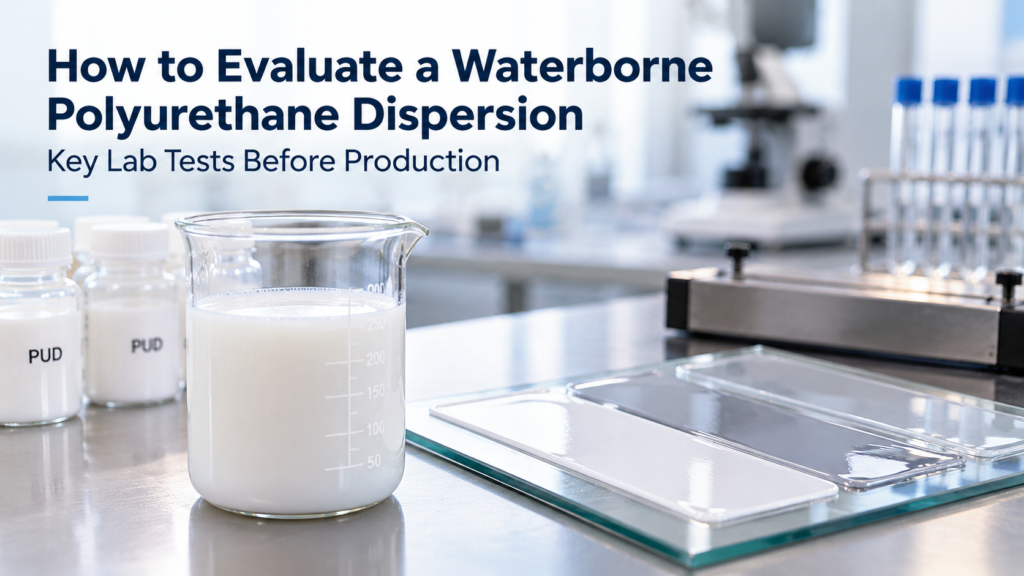
5. How to Evaluate a Crosslinked PUD Formulation
A controlled testing process helps determine whether a crosslinker provides a meaningful improvement.
A practical laboratory evaluation may include the following steps:
Step 1: Establish a baseline
Prepare a PUD formulation without the additional crosslinker. Record its appearance, pH, viscosity, and solids content where applicable.
Step 2: Prepare crosslinked samples
Prepare additional samples using compatible crosslinkers at controlled addition ratios. Change one variable at a time so that the results can be compared.
Step 3: Check formulation stability
Observe the mixtures for coagulation, separation, abnormal viscosity changes, or other signs of incompatibility.
Step 4: Apply coating samples
Apply the formulations to the intended substrate using consistent application conditions and wet-film thickness.
Step 5: Evaluate the dried or cured films
Depending on the application, evaluate:
- Water resistance.
- Chemical resistance.
- Adhesion.
- Abrasion resistance.
- Flexibility and elongation.
- Film appearance and uniformity.
Step 6: Compare the results
Compare the crosslinked samples with the baseline formulation. Select the formulation that provides the required performance while maintaining acceptable processing and application characteristics.
6. Choosing the Right Crosslinker for Your Application
The right crosslinker depends on the PUD chemistry, application requirements, and production process.
| Consideration | What to evaluate |
|---|---|
| PUD chemistry | Available reactive functional groups and compatibility |
| Target performance | Water, chemical, abrasion, or mechanical resistance |
| Processing conditions | Mixing, application, drying, and curing |
| Heat sensitivity | Whether the substrate can withstand the required curing temperature |
| Working time | Pot life and formulation stability |
| Safety requirements | Handling, storage, and applicable regulations |
For applications requiring room-temperature or lower-temperature processing, a compatible water-dispersible polyisocyanate may be worth evaluating.
For applications that use a suitable baking process, a blocked polyisocyanate may be considered.
Aziridine crosslinkers may also be relevant for selected PUD chemistries, provided that their compatibility and handling requirements are properly assessed.
7. SIWO Waterborne Polyurethane Crosslinker Solutions
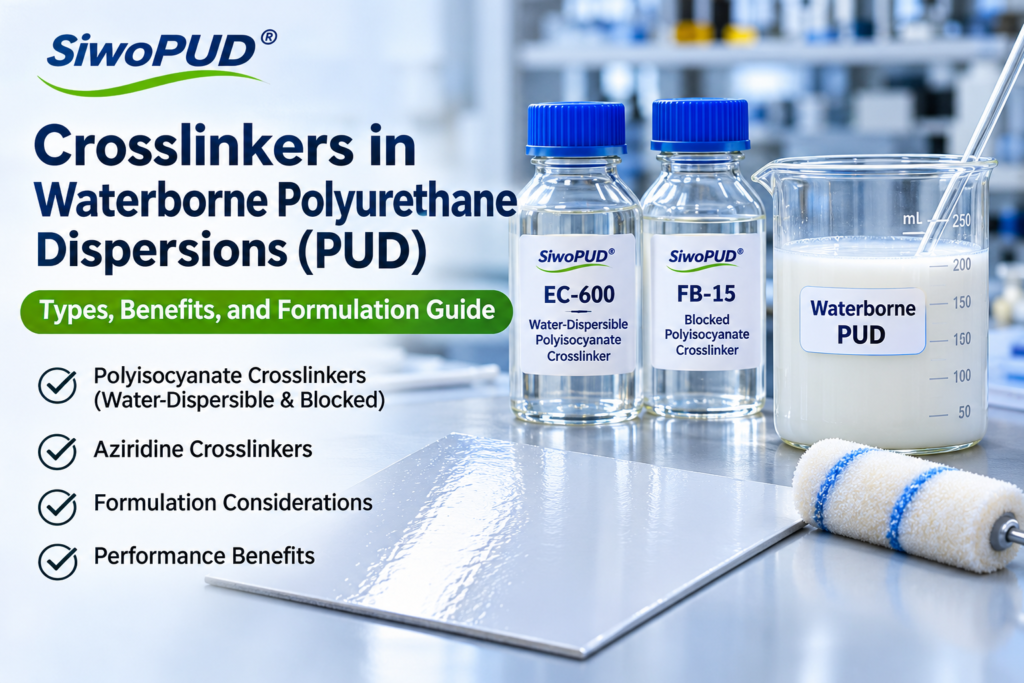
SIWO offers crosslinker products for waterborne polyurethane formulation development, including water-dispersible polyisocyanate and blocked polyisocyanate products.
These include:
- SiwoPUD®-EC-100, EC-200, and EC-600: Water-dispersible polyisocyanate crosslinker products.
- SiwoPUD®-FB-10, FB-12, and FB-15: Blocked polyisocyanate crosslinker products with different deblocking characteristics.
The appropriate product should be selected according to the PUD chemistry, formulation requirements, and processing conditions.
For more information, visit SIWO’s water-dispersible polyisocyanate crosslinkers and waterborne blocked polyisocyanate crosslinkers product pages.
Conclusion
Crosslinkers can play an important role in modifying the performance of waterborne polyurethane formulations. Polyisocyanate and aziridine crosslinkers offer different chemical approaches, and their suitability depends on the PUD structure, target properties, and production conditions.
Successful formulation requires more than selecting a crosslinker. Compatibility, addition ratio, pot life, mixing procedure, and curing conditions must all be evaluated.
By conducting controlled laboratory trials and comparing results against an uncrosslinked baseline, formulators can make more informed decisions and develop waterborne PUD systems suited to their application requirements.
Looking for a suitable crosslinker for your waterborne polyurethane formulation? Contact SIWO to discuss your application and technical requirements.